• Home
  • Blog
  • Recent Posts

    • Anti-Glamour Jobs in Australia That Can Still Pay Rent
    • Suburb Personality Test: Community or Property Portfolio?
    • Australia’s Cheapest Flatmate Might Be a Grandparent
    • Online Store Security Basics: HTTPS, Updates, and Backups
  • Home (Portada)
  • News in English
  • Noticias en Español
Home » For Beginners

Suburb Personality Test: Community or Property Portfolio?

Posted On 2026-04-29
0


0
Shares
  • Share On Facebook
  • Tweet It

Why Some Australian Suburbs Feel Slightly Hollow

You can feel it before you can prove it. The shops are technically open, but half the strip feels temporary. The houses look expensive, but the footpaths feel empty. There is plenty of “opportunity” language, not much ordinary life. The suburb does not feel dead. It feels managed.

That is the point of this personality test. It asks whether your area functions like a community, where people live, know things, use shared space, and build routines, or whether it is drifting toward a property portfolio, a place discussed more as stock than as a neighbourhood.

This is not a valuation tool, a buyer’s agent trick, or investment advice. It is a housing and neighbourhood reality check. The goal is to notice which places still behave like communities, and which ones are being flattened into asset class language.


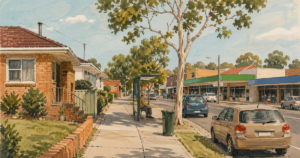
Uploaded ImageThe Suburb Personality Test

A lot of Australian housing talk now sounds like it was written by somebody standing inside a spreadsheet. That would be less annoying if it stayed on finance pages. Instead, it leaks into how people talk about streets, schools, cafés, renters, and whether a place is “worth it.”

The test below is deliberately simple. It is not scientific. It is useful.

Quick checklist

Give your suburb one point for each statement that feels true most of the time.

  • [ ] People use shared space for ordinary reasons, not just for commuting through it.
  • [ ] The local strip has practical businesses, not just beauty, branding, and vacant retail.
  • [ ] There are visible signs of long-term life: school pickup traffic, dog walkers, familiar shop staff, clubs, community noticeboards, old chairs on front verandas.
  • [ ] At least some housing looks lived in, not permanently presentation-ready.
  • [ ] You could name two places nearby that are genuinely useful without sounding like a real-estate brochure.
  • [ ] Public transport, schools, medical care, and daily essentials are close enough to matter in real life.
  • [ ] The suburb would still make sense to live in if property prices stopped rising for five years.

Score it like this

  • 5 to 7 points: Mostly a community. Imperfect, possibly expensive, probably annoying in some specific local way, but still a place for actual life.
  • 3 to 4 points: Mixed personality. The suburb is still functioning, but property logic is starting to out-muscle social logic.
  • 0 to 2 points: Strong portfolio energy. People may live there, but the place is increasingly being organised around investment narratives, not neighbourhood usefulness.
Por Otro Lado:  How to Start a Neighborhood Pigeon Advisory Board

Why this test exists at all

It exists because the Australian housing market keeps rewarding things that are not always the same as local health. ABS said the number of new investor loan commitments for dwellings rose 5.5% in the December quarter of 2025, and the September quarter had already hit the highest number of investment loans since March quarter 2022. That does not mean investors are the villain in every postcode. It does mean investment activity is still a major force shaping what suburbs become.

Signs You Live in a Community

A community is not a fantasy village. It is a place where daily life makes sense.

The useful signs are boring

The strongest sign is not “vibe.” It is practical coherence. Can people get to school, work, groceries, a GP, and public transport without turning every day into a logistical stunt? AHURI’s recent work on well-located housing makes the same point in policy language: high-amenity areas have good access to public transport, schools, medical services, employment opportunities, and leisure activities.

That matters because a suburb can look polished and still be badly organised for life. Fancy houses do not cancel bad access. A giant kitchen island does not replace a bus route. Community starts to show up when the suburb supports routines rather than just resale stories.

A real-life pattern worth noticing

A community suburb usually has at least some friction that proves people actually live there. The café owner knows who wants decaf. The school crossing gets busy at the same time every day. Someone complains about leaf blowers in the local group. The hardware shop survives because people are fixing things, not just styling them for inspection photos.

These are not cute details. They show the suburb is still being used as a place, not mainly held as a position.

Signs You Might Be Living in a Property Portfolio With Trees

This is the satirical part, but only just.

The portfolio signals

  • The suburb gets described constantly as “up-and-coming” even though nobody can explain what daily life there is actually for.
  • The local strip has more styling than substance. Great candles, no chemist.
  • There are key safes, short-stay instructions, or constantly rotating weekend luggage in pockets that used to feel residential.
  • Houses look immaculate from the street but strangely absent after dark.
  • Every second conversation about the area turns into yield, growth, zoning upside, or “owner-occupier appeal.”
  • You hear more about what the suburb is becoming than what people there currently need.
Por Otro Lado:  The First 10 Things to Fix

Some of these clues overlap with tourism pressure and short-stay conversion. AHURI reported in late 2025 that Australia’s short-term rental sector is becoming increasingly professionalised and that entire-home rentals outnumber shared stays. Again, that does not make every holiday area fake. It does explain why some places start feeling less like neighbourhoods and more like managed inventory.

A dated reality check

Australia’s 2021 Census counted 1,043,776 unoccupied private dwellings, equal to 10.1% of private dwellings on Census night. That figure does not prove all of those homes were empty in the same way, but it is still a reminder that “housing stock” and “homes full of ordinary life” are not identical categories.

Mini contrast: community versus portfolio

Signal Community suburb Portfolio suburb
Local strip Useful and repetitive Branded and oddly thin
Street life Routine, visible, mildly messy Tidy, sparse, intermittent
Housing talk Schools, transport, neighbours, daily convenience Growth, upside, scarcity, yield
Empty homes feeling Some, but not defining Noticeable enough to change the mood
Main local anxiety Parking, noise, school catchment stress “How do we preserve value?”

What This Test Gets Wrong, and Why That Matters

A good test should admit its limits.

First, some genuinely strong communities look quiet from the outside. Older suburbs can be stable, private, and lightly used in public without being hollow. Regional towns can have patchy shopfronts and still have real local loyalty.

Second, property investment and community are not automatic enemies. Plenty of investors hold rental homes long-term, and AHURI research published in 2025 found two broad landlord behaviours: roughly half of rental properties are held for two years or less, while nearly a third are held for more than 20 years. Those are not the same type of market actor, and suburbs feel the difference.

Third, this test is not permission to sneer at renters, tourists, new arrivals, or anybody who does not fit somebody else’s nostalgic suburb ideal. The real problem is not change. It is when a place is stripped of practical usefulness and still marketed as a success.

Por Otro Lado:  How to Create a Contact Us Page That Cuts Support Emails

The More Useful Question to Ask About Any Suburb

The sharper question is not “Is this suburb desirable?” That question is too easy to hijack. Ask this instead: Does this place still help ordinary people live ordinary lives?

That means checking whether homes are near the things life actually runs on. It means asking whether the local economy serves residents, not just perception. It means noticing whether the place still tolerates a bit of lived-in mess, a scooter on a lawn, kids at the bakery, a neighbour borrowing a ladder, instead of becoming a showroom for capital growth.

This is also where the joke turns serious. A suburb can accumulate value while losing usefulness. When that happens, the place is not becoming more successful in any human sense. It is just becoming easier to talk about at an auction lunch.

The best suburbs are not the most polished ones. They are the ones that still make room for regular life.


FAQ

Q1. Is this article saying investors ruin every suburb?
A1. No. The point is narrower. Investment activity can shape how a place functions, but the real test is whether the suburb still works for day-to-day life, not whether investors exist at all.

Q2. Does an empty-looking street automatically mean a bad suburb?
A2. No. Some places are naturally quieter, older, more private, or more seasonal. The useful question is whether the quietness reflects stable daily life or a thinning-out of local usefulness.

Q3. Why focus so much on schools, transport, and medical care?
A3. Because a suburb that photographs well but fails on practical access is often more portfolio-friendly than people-friendly. Australian housing research increasingly treats those services as core parts of well-located housing.

Q4. Is this a property buying guide?
A4. No. It is general commentary and education only. It is not financial, tenancy, or legal advice, and it is not a recommendation to buy, sell, rent, or avoid a specific suburb.


References

Disclaimer

This post is general educational commentary only. It is not property, legal, tenancy, or financial advice. Suburb conditions vary widely, and a playful checklist is not a substitute for local due diligence or professional advice.

0
Shares
  • Share On Facebook
  • Tweet It


Trending Now
Anti-Glamour Jobs in Australia That Can Still Pay Rent
Daisy I. 2026-04-29
Suburb Personality Test: Community or Property Portfolio?
Daisy I. 2026-04-28
Anti-Glamour Jobs in Australia That Can Still Pay Rent
Read Next

Anti-Glamour Jobs in Australia That Can Still Pay Rent

  • Recent Posts

    • Anti-Glamour Jobs in Australia That Can Still Pay Rent
    • Suburb Personality Test: Community or Property Portfolio?
    • Australia’s Cheapest Flatmate Might Be a Grandparent
    • Online Store Security Basics: HTTPS, Updates, and Backups
    • Public Safety Is a Maintenance Budget, Not a Mood
    • How to Start a Neighborhood Pigeon Advisory Board
    • How to Create a Contact Us Page That Cuts Support Emails


  • Terms of Use
  • Privacy Policy
  • Home / Inicio
© Raxan.comEntertainmnet - All Rights Reserved - DMCA Policy
Press enter/return to begin your search