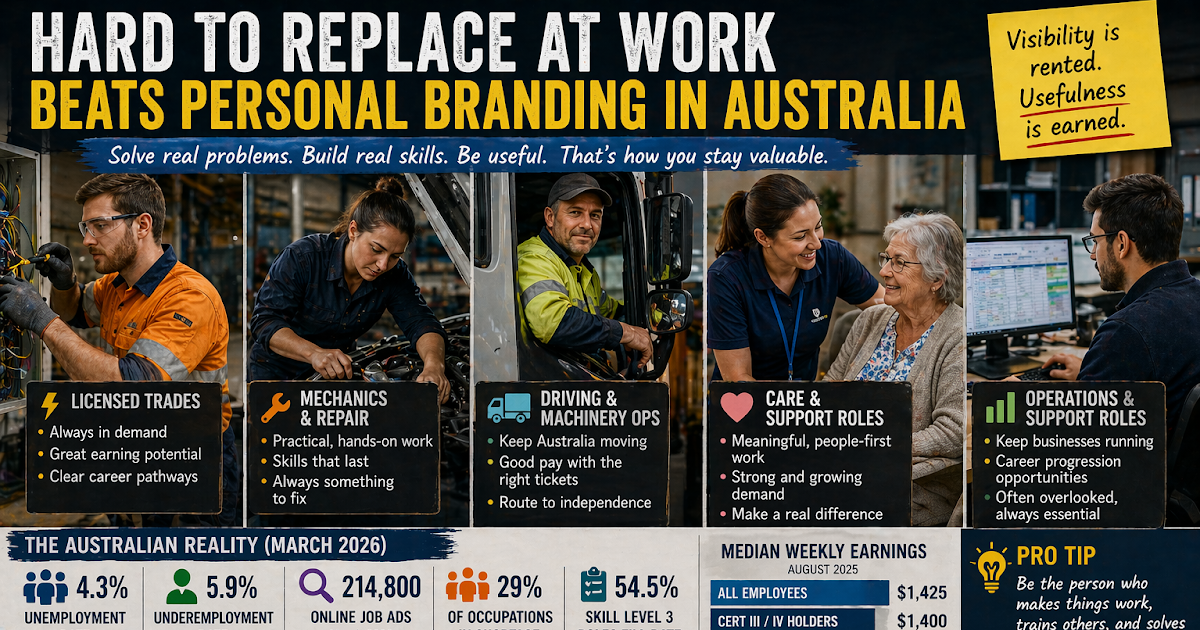




Hard to Replace at Work Beats Personal Branding in Australia
Why Easy-to-Brand Careers Keep Getting Over-Sold
Australia has spent years marinating in career advice that sounds better on a podcast than it works in a rent-paying life. Build your personal brand. Be visible. Post your wins. Become known. Some of that can help, especially in fields where audience, trust, or client attraction is part of the job.
But for most workers, visibility is not the same thing as value. A polished online presence does not fix payroll, keep machinery running, calm an angry customer, pass a compliance audit, coordinate a roster, or train a new team member properly. The labour market is usually harsher and simpler than brand culture wants to admit. Employers pay more attention to costly problems getting solved than to tidy self-presentation.
That is the useful angle here. Becoming hard to replace is usually a stronger career move than becoming easy to notice. This is general educational information only, not personalised career, legal, or financial advice.
What “Hard to Replace” Actually Means
Hard to replace does not mean becoming a heroic one-person department. It does not mean staying online at midnight, hoarding knowledge, or making yourself so central that nobody else can function. That is not leverage. That is a burnout plan wearing business-casual clothes.
A worker becomes harder to replace when their value is clear, provable, and operationally painful to lose. Usually that comes from some mix of:
- a skill that takes time to learn properly
- a licence, ticket, or qualification that narrows the labour pool
- calm reliability in messy real-world situations
- knowledge of systems, clients, compliance, or workflows that actually matter
- the ability to make other people more effective, not just yourself
The key word is provable. “I am passionate and strategic” is branding language. “I can run this system, train the new starter, keep error rates low, and solve the problem when the process breaks” is labour-market language.
The Current Australian Labour-Market Reality
The case for becoming harder to replace is not abstract. In March 2026, Australia’s unemployment rate was 4.3% and underemployment was 5.9%. That is not a collapsed labour market, but it is also not the anything-goes hiring boom people were talking about a couple of years ago.
At the same time, demand for practical work is still solid. Jobs and Skills Australia says online job ads rose to 214,800 in March 2026, about 25% above the monthly average for 2019. Its 2025 Occupation Shortage List also found that 29% of assessed occupations were in shortage nationally. Shortages have eased from the peak, but they have not disappeared.
The detail matters even more. Jobs and Skills Australia’s December 2025 Occupation Shortage Report said Skill Level 3 roles still had a low fill rate of 54.5%. That is a useful reminder that Australia still struggles to fill plenty of mid-skill jobs, the kinds of roles often built through certificates, apprenticeships, hands-on experience, and repeatable competence rather than glossy self-marketing.
Pay data points in the same direction. ABS said median weekly employee earnings in August 2025 were $1,425, with Certificate III or IV holders on a median $1,400 compared with $1,000 for workers with no non-school qualifications. That does not mean every certificate is magic. It does mean concrete, recognised skill often carries more labour-market weight than vague professional polish.
Six Ways to Become More Valuable Without Becoming a Martyr
1) Pick problems that are expensive when they go wrong
The best career question is often not “What looks impressive?” It is “What becomes costly, chaotic, or risky when nobody competent is handling it?”
Think payroll, compliance, scheduling, maintenance, reconciliations, rostering, stock control, customer recovery, claims handling, documentation, quality assurance, technical support, and regulated work. These are not glamorous functions. They are the places businesses quietly bleed money when competence is missing.
2) Get one piece of proof an employer can verify fast
A licence, certificate, trade pathway, first-aid ticket, payroll system knowledge, safety qualification, or compliance credential does not make someone brilliant by itself. It does make them easier to trust at short notice.
That matters in an economy where employers still need capable people and do not always have time to guess who can really do the work. The cleaner your proof, the lower the risk for the next employer.
3) Build reliability that shows up under pressure
Lots of people look competent when nothing is breaking. The harder-to-replace workers are the ones who stay usable when the roster falls apart, the customer is furious, the deadline moves, or the system crashes at 4:40 pm on a Friday.
This does not require a dramatic personality. It usually looks like steadiness, follow-through, decent notes, and fewer avoidable mistakes. Boring, yes. Also highly employable.
4) Learn the process behind the task
A replaceable worker can do their own piece. A harder-to-replace worker understands what their piece affects upstream and downstream.
A care worker who understands documentation standards, referral pathways, and client continuity is stronger than one who only “has a good heart.” A warehouse worker who understands stock flow, error points, and handover timing is stronger than one who only lifts boxes quickly. A payroll officer who can spot an award-risk issue before it turns into a complaint is stronger than one who only pushes buttons.
5) Make other people less error-prone
One of the fastest ways to become valuable is to reduce friction for the team around you. Train cleanly. Write better handover notes. Build a checklist. Fix a repeated confusion point. Make the next person faster without making them dependent.
That is different from hoarding knowledge. Hoarding makes a workplace fragile. Useful systems make you promotable because they prove you understand the work deeply enough to improve it.
6) Protect your usefulness from turning into exploitation
This is the part a lot of career advice skips. Being hard to replace is good. Being taken for granted is not.
If every extra problem flows to you, if nobody documents your contribution, if your workload keeps growing without better pay, title, hours, or training, then your value may be helping the employer more than it helps you. Real leverage needs boundaries, evidence, and timing. Otherwise you are not building a career edge. You are subsidising bad management.
Brand Signals Versus Replaceability Signals
A personal brand is not useless. It is just often over-ranked.
Comparison Table
| Signal type | Looks good quickly | Helps hiring managers trust you fast | Helps you keep a job | Helps you move employers | Main weakness |
|---|---|---|---|---|---|
| Polished online presence | Yes | Sometimes | Not by itself | Sometimes | Easy to fake or overvalue |
| Concrete qualification or licence | Moderately | Yes | Often | Yes | Can go stale without experience |
| Reliable delivery under pressure | Not always visible | Yes, once seen | Yes | Yes, with proof or references | Harder to showcase online |
| Process improvement and team usefulness | Rarely flashy | Yes | Yes | Yes | Often under-credited if undocumented |
Quick Checklist
- [ ] Can I point to one skill that would take a replacement months, not days, to learn well?
- [ ] Do I have a qualification, system skill, or documented result that proves it?
- [ ] Would a manager or teammate describe me as reliable under pressure, not just pleasant?
- [ ] Am I learning the wider workflow, not just my narrow task list?
- [ ] Do I have evidence of results, cleaner processes, better accuracy, faster onboarding, fewer errors, stronger client retention?
- [ ] Am I protecting myself from becoming the unpaid fix for everything?
The Mistakes That Make People Look Busy but Stay Replaceable
Mistake 1: confusing visibility with scarcity
Being visible can help people notice you. It does not automatically make your work harder to substitute. Scarcity comes from skill depth, trust, and proven outcomes, not from being the loudest person summarising meetings online.
Mistake 2: choosing broad praise over specific usefulness
“Great communicator” sounds nice. “Reduced invoicing errors, trained two new starters, and kept the month-end process from blowing out” sounds employable.
The first description fits thousands of people. The second one starts narrowing the field.
Mistake 3: becoming indispensable in the wrong place
There is a trap here. Some workplaces love a highly capable person and then quietly pile on every broken responsibility until the role becomes impossible. If your competence is not translating into better terms, stronger references, a promotion path, or transferable proof, you may be getting used as a shock absorber.
Pro Tip: Track the work that saves time, money, risk, or customer pain. That is usually the evidence with the most bargaining power later.
What to Do Next If You Need a Career Reset
A career reset does not need a personality transplant. It needs a more useful filter.
Start with this decision guide
-
List the problems you can already solve.
Not your interests, your actual labour-market value. What do people trust you with when stakes are real? -
Circle the problems employers repeatedly pay for.
Think compliance, care, logistics, systems, operations, repair, service continuity, scheduling, safety, documentation, training. -
Choose one proof upgrade.
A ticket, certificate, software skill, qualification, or reference-worthy result. One concrete step beats ten vague intentions. -
Make your value legible.
Rewrite your resume or talking points around outcomes, reliability, and specific usefulness. Less “dynamic professional.” More “reduced handover errors” or “kept service levels stable during understaffing.” -
Set a boundary test.
If your role keeps expanding, decide what better pay, title, training, or flexibility would count as a fair exchange.
A short scenario
Imagine two workers in the same company. One posts thoughtful leadership content, attends every optional networking event, and is broadly well-liked. The other gets a certification the team actually needs, learns the reporting system no one else understands well, trains new staff faster, and documents a cleaner process that cuts repeated errors.
The first worker may be easier to remember. The second worker is usually easier to justify keeping, promoting, or rehiring.
The Better Career Goal Is Useful, Not Just Visible
The labour market does not reward every kind of value equally, and it definitely does not reward every kind of branding equally.
For most Australians trying to build a stable working life, the better question is not “How do I look more impressive?” It is “What can I do, prove, and improve that would be genuinely annoying to lose?”
That is the career hack hiding inside all the boring advice. Solve real problems. Get proof. Be steady. Learn the system. Keep receipts on your value. Then make sure the benefit flows back to you too.
FAQ
Q1. Does personal branding matter at all?
A1. Yes, sometimes. It can help in sales, creative work, consulting, leadership, or client-facing roles. The narrower point is that branding usually works best when it sits on top of real, provable value rather than trying to replace it.
Q2. Is becoming hard to replace the same as becoming indispensable?
A2. No. Indispensable often means overburdened and badly documented. Hard to replace means your skill, reliability, or proof is genuinely valuable, while the work is still professionalised enough that the organisation can function.
Q3. What if I work in a lower-paid role right now?
A3. Start by identifying which parts of your current role are easiest to verify and most useful to another employer. Then add one proof upgrade, a qualification, a system skill, a cleaner process result, or stronger references.
Q4. Can this approach work without university?
A4. Yes. Current ABS earnings data shows recognised qualifications below degree level still carry labour-market value on median earnings, and JSA shortage data shows many mid-skill roles remain difficult to fill.
References
- Australian Bureau of Statistics, Labour Force, Australia, March 2026 — Supports the March 2026 unemployment and underemployment figures.
- Jobs and Skills Australia, Internet Vacancy Index, March 2026 — Supports the 214,800 online job ads figure and the comparison with the 2019 average.
- Jobs and Skills Australia, 2025 Occupation Shortage List Key Findings Report — Supports the finding that 29% of assessed occupations were in shortage nationally in 2025.
- Jobs and Skills Australia, Occupation Shortage Report, December 2025 — Supports the Skill Level 3 fill-rate figure of 54.5%.
- Australian Bureau of Statistics, Employee earnings, August 2025 — Supports the median weekly employee earnings figure and the qualification-based earnings comparison.
Disclaimer
This post is for general educational purposes only. It is not personalised career, legal, or financial advice. Pay, job quality, training requirements, and progression vary by employer, award, state, and region. Check current role requirements and local labour conditions before making a major career decision.