
Your First Welcome Email Sequence
Why a welcome sequence matters early
A lot of small store owners start collecting email addresses before they really know what to send. The signup form goes live, people join the list, and then nothing happens beyond a basic confirmation email or a one-time discount. That is a missed chance.
A first welcome sequence helps new subscribers understand who you are, what kind of products you sell, and why they should keep paying attention. It also gives your store a calmer way to build trust without asking for a sale in every message.
For a small online store, this kind of email flow does not need to be elaborate. You do not need seven emails, fancy automation branches, or a full copywriting system. Most stores do well with a short sequence that introduces the brand, helps people browse, and gives them a low-pressure reason to come back.
What your first welcome email sequence should do
A welcome sequence is not just there to say hello. It should do a few clear jobs.
First, it should confirm that the subscriber made the right choice. If someone signs up for your list, they should get a quick email that feels on-brand, clear, and human. That first message sets the tone.
Second, it should explain what the store is about. A new subscriber may have joined because of a popup, a giveaway, a product they liked, or a first-order offer. That does not mean they fully understand the brand yet. The sequence can fill in that gap.
Third, it should help them take one useful next step. That might be browsing best sellers, learning what makes the products different, or using a first-order offer if you have one. The point is direction, not pressure.
A strong welcome sequence often does three simple things:
- introduces the store clearly
- helps the subscriber browse with less friction
- gives a reason to trust the brand a little more
That is enough for a first version.
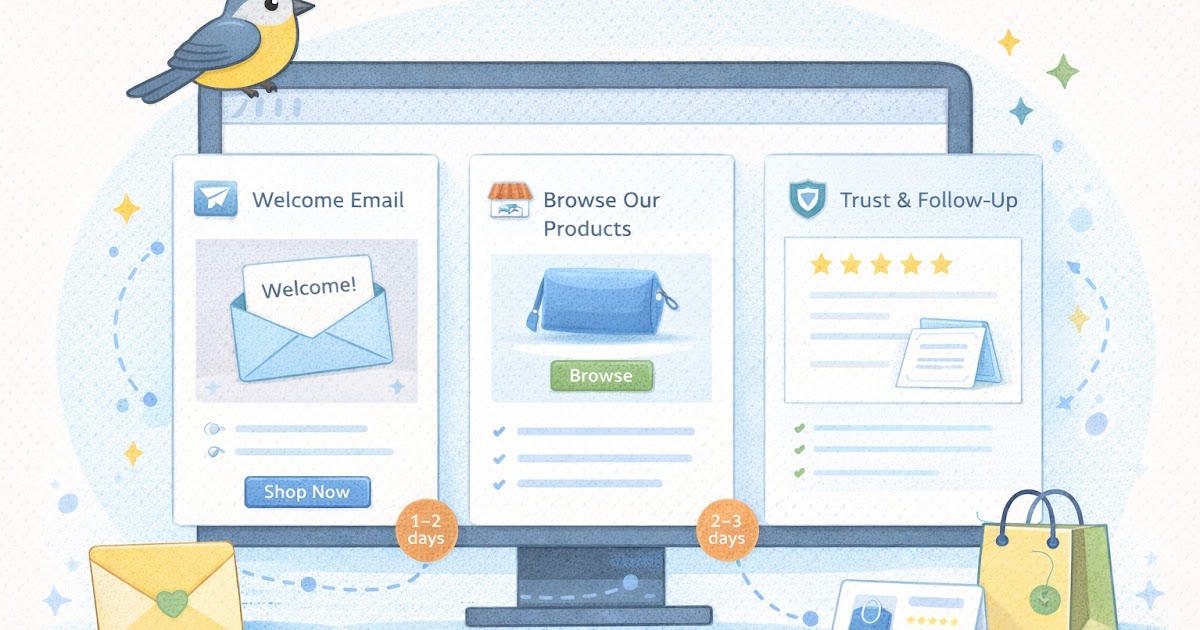
A simple first welcome sequence for a small store
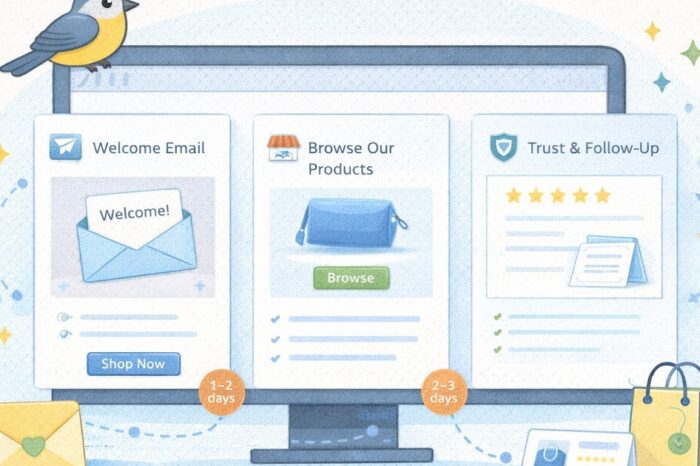
For many small online stores, a three-email sequence is a good place to start. It is manageable, easy to write, and covers the basics without feeling like too much.
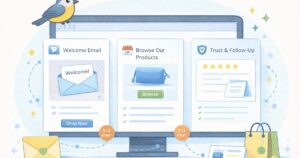
Email 1: The welcome email
This is the email that should go out soon after signup. Its job is simple: say welcome, confirm what the subscriber can expect, and point them somewhere useful.
This is where the “bienvenid@” energy can fit naturally if it matches the brand. Keep it light. The tone should feel warm, not forced.
A first welcome email might include:
- a short thank-you for joining
- one or two lines on what the store sells
- a note on what kind of emails they will get
- a simple next step, like browsing best sellers or new arrivals
- a first-order code, if you use one
Example direction: “Thanks for joining us. We make simple desk tools for small workspaces, with practical designs that are easy to use every day. You’ll get product updates, restocks, and a few useful tips from us, not daily noise.”
That works because it is clear and grounded.
Email 2: The brand-and-products email
This one can go a day or two later. It should help the subscriber understand the store better and reduce some of the uncertainty that comes with buying from a newer brand.
This email can do one or two of these things:
- explain what makes your products useful
- show a small set of best sellers
- highlight one product category
- share a short brand reason without turning into a big founder speech
A small travel-goods store might say: “We started this shop because it was too hard to find travel gear that felt practical without looking bulky. We keep the assortment small, focus on carry-friendly designs, and try to make the first choice easier.”
That gives the subscriber a reason to understand the brand without drowning them in story.
Email 3: The trust-and-next-step email
The third email can gently move closer to the first order, but it should still feel helpful. This is a good place to add trust cues, answer common concerns, or point people toward the right products.
You can include:
- customer favorites
- a short FAQ-style section
- shipping or returns basics
- a reminder of a welcome offer, if there is one
- a simple browse path like “Start here” or “Most-loved products”
This email works best when it lowers hesitation. For example, if people usually wonder about shipping speed, return windows, or what to buy first, address that directly.
A simple timing example
- Email 1: immediately after signup
- Email 2: 1 to 2 days later
- Email 3: 2 to 3 days after that
That is enough spacing to stay present without becoming annoying.
How to keep the sequence clear and useful
The biggest mistake in welcome emails is trying to say everything at once. A better sequence gives each email one main job.
The first email welcomes.
The second explains.
The third helps the subscriber move forward.
That structure keeps the writing clearer and the emails easier to scan. It also makes it easier for you to write them.
Practical steps
- Decide what one action each email should support.
- Keep the subject lines plain and readable.
- Use one main call to action per email.
- Write the copy like a person, not like a campaign brief.
- Check the emails on mobile before turning the flow on.
It also helps to keep design simple. A small store does not need a heavily designed email with six product blocks, banners, countdowns, and multiple calls to action. A cleaner email often feels more trustworthy.
The same goes for discounts. If you use a welcome code, treat it as support, not the whole strategy. A code can help, but the sequence should still explain the store clearly. Otherwise the list starts feeling trained to care only about the promo.
Common welcome email mistakes to avoid
One common mistake is sending only one email and expecting it to do everything. That usually creates a message that feels crowded. It thanks the subscriber, tells the brand story, lists product categories, pushes a discount, explains shipping, and asks for a sale all at once. Most people will skim and move on.
Another issue is sounding too promotional too early. A welcome sequence should sell in a quiet way, but it should not feel like a three-email shout. New subscribers often need a little context before they are ready to act.
There is also the problem of vague copy. If the email says “crafted with care for everyday moments,” the subscriber may still have no idea what you sell. Specificity matters here just as much as it does on the website.
Common mistakes
- putting too much into the first email
- using weak or vague subject lines
- sending emails with no clear next step
- making every email about the discount
- forgetting to explain what the store actually sells
- skipping trust details that would help first-time buyers
A simple example: imagine a small candle shop’s first email says, “Welcome to our world of cozy living.” That may sound nice, but it leaves out the useful part. A better version would say, “Welcome. We make small-batch candles with straightforward scent profiles and easy gift-ready packaging.” That gives the subscriber something real to hold onto.
A quick welcome sequence checklist summary
Quick checklist
- [ ] The sequence has a clear first version, not just one generic email
- [ ] Email 1 welcomes and sets expectations
- [ ] Email 2 explains the brand or product angle clearly
- [ ] Email 3 reduces hesitation and points to a next step
- [ ] Each email has one main job
- [ ] The copy says clearly what the store sells
- [ ] The design is easy to scan on mobile
- [ ] The call to action is simple and specific
- [ ] Trust details appear where they help
- [ ] The tone feels warm, not pushy
If several of these basics are missing, the sequence may still be running, but it is probably not doing enough work yet.
Start simple, then improve with real behavior
A first welcome sequence does not need to be clever. It needs to be useful. That is what helps a new subscriber go from “I signed up” to “I understand this store now.”
For a small online shop, the smartest move is usually to build a short sequence first, then improve it based on what people actually do. See which email gets opened. See where people click. See whether one message is carrying more weight than the others.
That kind of learning is easier when the first version is simple.
Gentle next step
Draft your first three welcome emails with one question in mind for each: what does this subscriber need to understand or do next? Keep each email focused, useful, and easy to scan. Sin estrés. A short sequence that clearly introduces the store will usually outperform a more “clever” one that tries to do too much.
FAQs
Q1. How many emails should be in a first welcome sequence?
A1. For many small stores, three emails are enough to start. That gives you room to welcome the subscriber, explain the brand, and guide the next step without overcomplicating the flow.
Q2. Should every welcome sequence include a discount?
A2. Not necessarily. A discount can help, but it is not required. The sequence can still work well if it focuses on clarity, browsing help, and trust.
Q3. How soon should the first welcome email send?
A3. Usually right after signup or very soon after. The subscriber should not be left wondering whether their signup worked.
Q4. What should I put in the last email of the sequence?
A4. A simple trust-building push works well, like customer favorites, shipping basics, returns info, or a clear “start here” browse path.
Trending Now