



Online Store Returns Policy: A Beginner-Friendly Guide
Why a clear returns policy matters
A lot of small store owners put off writing the returns policy because it feels legal, complicated, or easy to get wrong. Then the store goes live with a vague paragraph in the footer, and everyone hopes for the best. That usually works until the first return request lands in your inbox and nobody is fully sure what the rule is.
A better returns policy does not need to sound formal to work. It needs to sound clear, fair, and easy to follow. Shoppers mostly want to know three things: can I return this, how long do I have, and what happens next?
For a small online store, that clarity does two jobs at once. It helps customers feel more comfortable buying, and it helps the store handle awkward situations with less stress later. This guide stays at the plain-language level, not legal advice, because the goal is to help you build a solid starting point and avoid the usual confusion.
What a small store returns policy should cover
A good returns policy answers the practical questions before a customer has to ask them. It should not try to sound impressive. It should make the process understandable.
Start with the return window. This is one of the first details shoppers look for. Say how many days a customer has to request or send back a return. For many small stores, that might be 14, 21, or 30 days, depending on the product type and how the business operates. The right number depends on your margins, fulfillment process, and what feels realistic for your store.
Next, explain which items are eligible. This part matters because not every product should follow the same rule. Some stores accept returns on standard items but exclude final-sale products, personalized items, digital products, or hygiene-related goods. The key is to say that clearly before someone buys, not after there is a problem.
Then cover the condition requirements. Many stores expect returned items to be unused, unworn, unopened, or in original packaging. That is fine, but the wording should stay practical. “Items must be unused and returned in original packaging when possible” is easier to understand than policy language that sounds copied from a contract.
The basics to include
- Return window
- Which items can be returned
- Which items cannot be returned
- Condition requirements
- How to start a return
- Who pays for return shipping
- When refunds are issued
- What happens with damaged or incorrect orders
Those are the pieces that do most of the work. If they are easy to find and easy to read, your policy is already stronger than a lot of small-store policies.
How to write the policy in plain language
This is where many policies go off track. The store owner knows what they mean, but the customer has to read the same sentence twice to understand it. That extra friction matters.
Start with direct wording. Instead of “Returns are subject to prior authorization and review,” say “Email us within 14 days of delivery to start a return.” That gives the shopper an action and a timeline right away.
It also helps to break the policy into small sections. A block for eligibility, a block for return steps, and a block for refunds is usually easier to scan than one giant paragraph. Most people will read this page on a phone, not on a big monitor with lots of patience.
A plain-language policy usually answers each question in the order a customer would ask it:
- Can I return it?
- How long do I have?
- What condition should it be in?
- How do I contact you?
- Who pays for shipping?
- When do I get my money back?
That order feels natural because it follows the customer’s real concern, not the business’s internal process.
A simple example structure
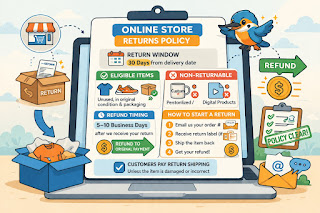
You do not need complicated wording to sound professional. A practical structure can look like this:
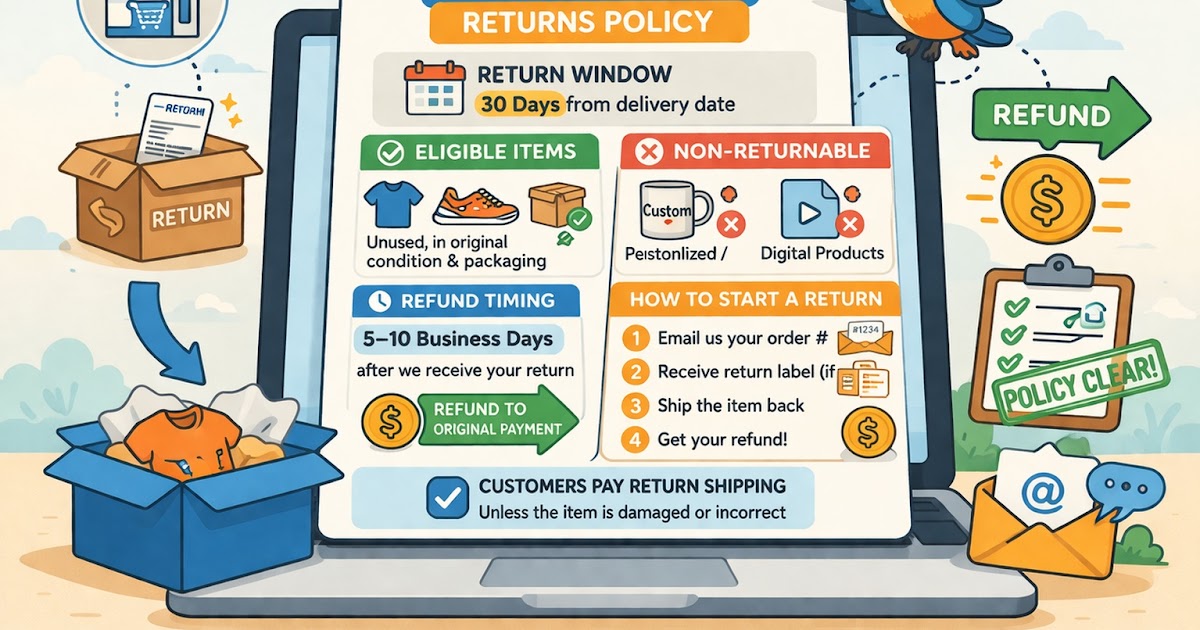
Return window
You can request a return within 30 days of delivery.
Eligible items
Unused standard items may be returned. Personalized items and final-sale items are not eligible.
How to start
Email us at [email protected] with your order number and the reason for the return.
Return shipping
Customers are responsible for return shipping unless the item arrived damaged or incorrect.
Refunds
Once we receive and inspect the return, refunds are issued to the original payment method within 5 to 10 business days.
That is not fancy, but it is useful. It tells the customer what to do and tells the store what standard to follow.
A little honesty also helps. If your small store cannot offer free returns, say so clearly. If processing takes a few business days, say that too. A realistic policy builds more trust than a generous-sounding one that turns into a support headache later.
Common returns policy mistakes to avoid
One common mistake is trying to sound legal instead of understandable. That often leads to vague phrases like “subject to approval” or “determined at our discretion” without enough explanation. In some cases, that kind of wording may be necessary in a full policy, but if it is the only thing the shopper sees, it creates uncertainty.
Another issue is being too generous on paper without thinking through operations. A founder may write “free returns on everything” because it sounds customer-friendly, then realize the return costs eat into already-thin margins. A policy should feel fair to the customer, but it also has to be workable for the business.
There is also the problem of hiding the policy. If the only link is buried in the footer and the product page says nothing, shoppers may feel unsure before checkout. A short returns summary on product pages, plus a full returns page, usually works better.
Common mistakes
- Leaving the return window unclear
- Not separating eligible and non-eligible items
- Forgetting to explain return shipping costs
- Using formal wording that hides the real meaning
- Writing a policy that the business cannot actually follow
- Failing to update the page when the process changes
One more thing to watch is consistency. Your FAQ, product pages, email templates, and returns page should not all say different things. If one page says 14 days and another says 30, customers will notice, and support gets harder fast.
A simple example: imagine a small accessories store that sells phone cases and personalized keychains. It is reasonable to allow returns on the standard phone cases and not on custom keychains. The problem only starts when that difference is not stated clearly before purchase. That is not just frustrating, it can also make the store feel less trustworthy than it really is.
A quick returns policy checklist summary
Quick checklist
- [ ] The return window is clearly stated
- [ ] Eligible and non-eligible items are listed plainly
- [ ] Condition requirements are easy to understand
- [ ] The steps to start a return are simple
- [ ] Return shipping responsibility is clear
- [ ] Refund timing is included
- [ ] Damaged or incorrect order instructions are included
- [ ] The wording sounds human, not overly legal
- [ ] The policy matches what the store can actually handle
- [ ] Product pages or FAQ pages support the same policy details
If several of these points are missing, the policy may still confuse shoppers even if the business thinks the rule is obvious.
Keep it clear, fair, and easy to find
A strong returns policy is not about writing the longest policy. It is about making the basic expectations easy to understand before there is a problem.
For a small online store, the best first move is to choose a return approach you can actually manage, then write it in plain language. That may mean a shorter return window, no free return shipping, or exclusions for custom products. That is okay. What matters most is that the policy feels clear and consistent.
Policies like this do quiet work. They reduce friction before checkout, help support conversations go faster, and make the store feel more complete. That is a good return for one page.
Gentle next step
Draft your returns policy in one pass using simple section headings: return window, eligible items, how to start, shipping, and refunds. Then read it out loud. If it sounds harder than a normal customer-support email, simplify it. Sin estrés. A policy that people can actually understand is usually the one that helps most.
FAQs
Q1. How long should a return window be for a small online store?
A1. There is no single right answer. Many small stores choose a window that matches their margins, product type, and operations, often somewhere between 14 and 30 days for standard items.
Q2. Can a small store exclude some items from returns?
A2. In many cases, yes. Custom, final-sale, digital, or hygiene-sensitive items are commonly treated differently, but the policy should explain that clearly before purchase.
Q3. Should a returns policy include legal language?
A3. It may need some formal wording depending on the business and location, but the customer-facing version should still be understandable. Plain language usually builds more trust than complicated phrasing.
Q4. Where should the returns policy appear?
A4. A full returns page is helpful, and a short summary on product pages or in the FAQ can make the main points easier to find.